_edited.jpg)

Panel on Safe & Trusted AI in Africa at India AI Impact Summit

The India AI Impact Summit took place from February 16th to 20th, 2026, at Bharat Mandapam in New Delhi, India. The event featured a diverse range of participants from around the world, including policymakers, researchers, developers, investors, members of civil society, academics, and media representatives, among others. The summit provided excellent opportunities for stakeholders to influence its outcomes, including the ability to curate tailored sessions during the main event. This report highlights the key takeaways from the session we co-organized, “Tech Governance Project,” along with the ILINA Program and AI Safety South Africa. The session convened African policymakers, researchers, civil society, and innovation leaders, during which the discussion explored how the African region can meaningfully engage in safe, trusted AI governance, focusing on catastrophic and dual-use AI risks. The session begins with introductions, followed by panel discussions and open Q&A between the attendees and panelists, guided by the moderator. Recording of the session can be accessed here.
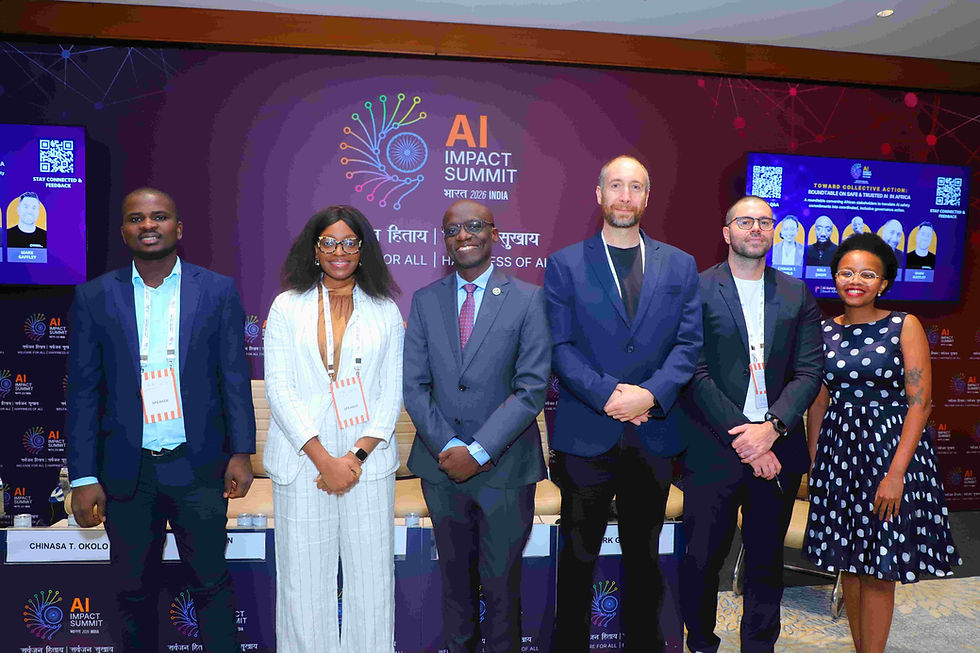
Key questions explored by the panelists include AI safety in the context of Africa; how far existing efforts to advance AI safety on the continent have gone, and promising pathways for cooperation on AI safety and governance beyond borders.
Key takeaways from the discussion are:
Existing Efforts and Progress: The discussion highlighted that African governments have made substantial progress in ensuring the development of safe and trustworthy AI. Cited examples include the various national AI strategies and frameworks across the continent, such as the Continental AI Strategy and the launch of the Africa AI Council. Furthermore, the discussion emphasized that the establishment of the African Computing Initiative at the University of Cape Town is an evaluation infrastructure enablement that will allow local researchers to enhance the trustworthiness and safety of AI development.
Catastrophic and Dual-use AI Risks: The discussion emphasized the need to reframe "existential" and "catastrophic" risks to better fit the African context. The discussant highlights existential threats as those that impact the harmony of society, democracy, and civilization itself. Likewise, one of the discussants views catastrophic outcomes as the extraction of African data and the capture of markets, with African institutions reduced to "mere users." Furthermore, the rise of autonomous agents that could destabilize elections and social trust was also highlighted as a concerning issue. Additionally, the capacity for AI to scale targeted, gendered disinformation and violence against public figures was noted. A long-term risk of "mental arrest" or cognitive decline was also mentioned, where over-reliance on AI leads to a loss of independent reasoning.
Engagement in Governance: The discussion highlighted several ways to improve African policymakers' involvement in safe and trustworthy AI, including increasing fluency and technical capacity within the public sector. Civil society coalitions were also emphasized as a strong advocacy route, especially when formal government feedback channels are limited. Public awareness campaigns through both formal and informal education, using relatable imagery and caricatures, were identified as essential for encouraging informed decision-making since most citizens are unaware of AI. Additionally, the involvement of the African diaspora was seen as a crucial resource to strengthen national and regional AI efforts. Regarding targeted engagement, three key groups are noted: scientists (who need model access), governments (who require negotiation skills), and citizens (who need inclusion in safe environments). Regarding negotiation skills, one of the discussants noted that their team is working on a guidebook and negotiation tool to help government officials negotiate from a position of knowledge.
Coordination and Cooperation: The discussions stressed that national competitions within the continent are not a viable option and instead encouraged collaboration that can be leveraged to apply market pressure on big tech companies. The African Computing Initiative was highlighted as a crucial coordinating infrastructure, providing researchers on the continent with access to high-performance computing clusters and GPUs for resource sharing. Empowering existing grassroots organizations like Masakhane or Deep Learning Indaba was also recognized as a strong strategy to build a powerful network effect across Africa. For regional goal alignment, leveraging the Africa AI Council and the AU Continental AI Strategy was regarded as essential. On the global level, ensuring active participation in international bodies, such as the UN’s International Scientific Panel on AI and the High-Level Advisory Body on AI, was identified as a key approach to ensuring African voices are heard in global governance.
The discussion points emphasize ongoing efforts to promote safe and trusted AI across the continent, along with ideas for enhancing stakeholder engagement in the region on this topic. It also underscores the expectation that coordination and cooperation will improve both governance and collaboration, as well as regional and global ecosystem development.
A key opportunity from this session is to foreground catastrophic AI risks in ways that are grounded in African contexts, which are frequently underexplored in African AI discourse. This opens the door to deeper analysis and the development of contextually relevant strategies to reduce these risks.
The launch of the Global South Network for Trustworthy AI at the summit represents a hopeful step towards incorporating relevant considerations into the governance of catastrophic and dual-use AI risks in the wider Global South.
We are optimistic about the prospects, and the momentum the session begins igniting, such as the public endorsements by some of the participants (see Faidat, Amb. Philip, Chinasa).
We thank our panelists for their insights and contributions:
Amb. Philip Thigo
Prof. Jonathan Shock
Dr. Chinasa T. Okolo
Mark Gaffley
We look forward to building on this momentum to expand the AI governance conversation and efforts in the region.


Comments